
5052 and 5154 aluminum strips are currently the two most mature aluminum alloy materials used in cable armoring applications. 5154 can be considered a higher-strength version of 5052, providing greater mechanical strength to the armoring layer.
- 5052 is a general-purpose and balanced choice: it provides excellent economy and corrosion resistance while meeting standard armoring strength, making it the most widely used "all-rounder."
- 5154 is the high-strength and harsh-environment choice: when cables are subject to higher pressures or more severe environmental conditions, its strength, which exceeds that of 5052 by about 20%, is its main advantage.
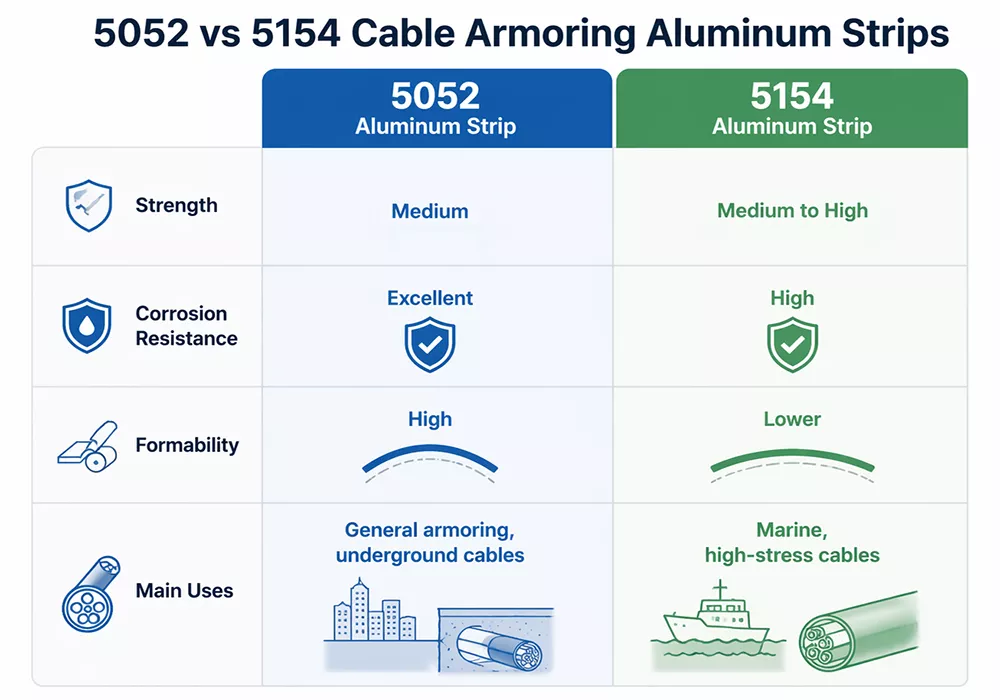
5052 vs 5154 Cable Armoring Aluminum Strips
| Comparison Dimensions | 5052 Aluminum Alloy Strip | 5154 Aluminum Alloy Strip |
| Chemical Composition (Mg) | Lower magnesium content: approximately 2.2% - 2.8% | Higher magnesium content: approximately 3.1% - 3.9%, which is the fundamental reason for its 20% higher strength. |
| Tensile Strength | Medium strength | Medium to high strength |
| Corrosion Resistance | Excellent (especially suitable for marine environments) | High quality (higher magnesium content) |
| Formability | High (suitable for tight wrapping) | Slightly lower due to higher hardness |
| Standard Condition | Common delivery conditions: H22, H24, etc. | Similar delivery conditions to 5052, with different processing work-hardened states chosen based on performance needs. |
| Main Uses | General armoring, underground cables | Marine cables, high-stress environments |
Why Choose 5052 and 5154 Aluminum Strips for Cable Armoring?
When it comes to cable armoring, selecting the right materials is crucial for ensuring both performance and durability. Two popular choices for armored cable strips are 5052 and 5154 aluminum alloys. Here's why these alloys are ideal:
- Enhanced Durability: Both 5052 and 5154 alloys offer exceptional resistance to moisture, corrosion, and environmental stress, ensuring long-lasting protection for armored cables.
- Lightweight Design: Compared to traditional steel, aluminum is significantly lighter. This reduces the overall weight of the cable, leading to easier installation and lower shipping costs, making it an economical choice for manufacturers.
- Good Electrical Conductivity: While not as conductive as copper, aluminum still provides excellent conductivity, making it a reliable option for cables that require safe and efficient power transmission.
For the highest quality aluminum strips for cable armoring, Haomei Aluminum offers premium-grade 5052 and 5154 alloys, ensuring optimal performance in every application.
Advantages of 5052 and 5154 Armored Aluminum Strips
Corrosion Resistance
The magnesium content in these alloys helps form a self-healing oxide layer. This is crucial for underground or subsea power cables, as moisture and salt can corrode galvanized steel or low-grade aluminum materials.
Weight Efficiency
Aluminum's density is about one-third of that of steel. Using 5052 or 5154 aluminum strips allows for the creation of lighter cable components, reducing transportation costs and making installation (through conduits) easier.
Magnetic Shielding
Unlike steel armor, aluminum is non-magnetic. In high-voltage AC cables, magnetic armoring can cause energy loss due to eddy currents and hysteresis. Aluminum can eliminate these losses, improving the overall efficiency of power transmission.
Mechanical Protection
5052-H38/H39: Commonly used in situations requiring a balance of flexibility and compressive strength.
5154: Chosen for cables that require higher tensile strength to withstand longitudinal tension during deep-sea or long-span installations.
Common Applications of Armored Cables
Armored cables are designed to protect electrical wiring from physical damage, corrosion, and environmental stress. Whether for high-voltage power transmission, marine environments, or industrial sectors, armored cables offer enhanced safety, reliability, and durability. Below are some of the common applications of armored cables:
Power Transmission: Armored cables are widely used in high-voltage power transmission lines, especially in areas where protection is critical. By using armored cables, the risk of mechanical damage, piercing, and compression to the cables is significantly reduced, ensuring stable operation of the power system. Armored cables are commonly used in urban power grids, industrial power systems, and other large-scale infrastructure projects.
- Impact Resistance: During power transmission, armored cables can withstand compression from heavy objects or construction equipment, reducing the risk of cable damage.
- Prevention of Electromagnetic Interference: The armored layer helps reduce electromagnetic interference, ensuring stable signal transmission, especially for high-voltage power lines.
- Extended Lifespan: The armored layer protects the cables from environmental factors, extending their lifespan and reducing maintenance costs.
Marine Cables: Marine cables play a vital role in offshore energy, communications, and underwater monitoring systems. Given the high corrosion and pressure levels in marine environments, armored cables significantly improve the durability of cables in these harsh conditions.
- Corrosion Resistance: The metal layer in armored cables has excellent corrosion resistance, preventing seawater from damaging the cables, ensuring long-term stability even under immersion.
- Pressure and Mechanical Damage Resistance: In marine environments, cables often face physical impacts from water currents, sediment, and underwater equipment. Armored cables can withstand these forces, protecting the internal conductors.
- Improved System Reliability: Subsea power transmission systems require high reliability, and armored cables help reduce the occurrence of cable failures, improving the overall stability of the system.
Industrial and Military Applications: Industrial and military sectors often face extreme working conditions, including high temperatures, exposure to chemicals, and high physical pressure. Armored cables provide strong protection in these environments, ensuring stable power and data transmission.
- High Temperature and Chemical Resistance: The outer layer of armored cables is typically made of high-strength materials that can withstand high temperatures and chemical corrosion, making them suitable for high-risk industries like oil and gas, and mining.
- Water and Dust Resistance: In underground and high-humidity environments, armored cables provide additional protection, ensuring stable power transmission despite environmental challenges.
- Improved Reliability of Military Equipment: In military applications, armored cables prevent mechanical damage and electronic interference, ensuring the stable operation of communication and power systems.
Other Special Applications: In addition to the common applications mentioned above, armored cables are also used in the following fields:
- Mining and Tunnel Engineering: In specialized environments like mines and tunnels, armored cables are capable of withstanding physical impacts and chemical corrosion, ensuring reliable power supply for mining equipment and ventilation systems.
- Renewable Energy: Armored cables are used in wind power generation and solar power systems to connect components, ensuring stable power transmission even under harsh weather conditions.
- Transportation and Rail Systems: In urban transportation and railway systems, armored cables are used for power and signal systems, protecting the transmission of electricity from external environmental influences.
From the above, it's clear that armored cables play a key role in various industries. Whether it's for power transmission, marine cables, or industrial and military applications, they offer stronger protection and longer lifespans for electrical systems.