
The purity of 1060 aluminum is higher than that of 1050 (99.6% vs 99.5%), resulting in better conductivity, making it the more common choice for transformer windings today. 1050 aluminum, on the other hand, offers sufficient performance and cost advantages, and is still widely used in applications with less stringent conductivity requirements, such as low-voltage transformers.
The choice between 1050 and 1060 aluminum strips is a balance between performance and cost. 1050 focuses on high cost-effectiveness, suitable for standard applications, while 1060, with better conductivity, has become the mainstream choice for transformer windings that prioritize higher efficiency.
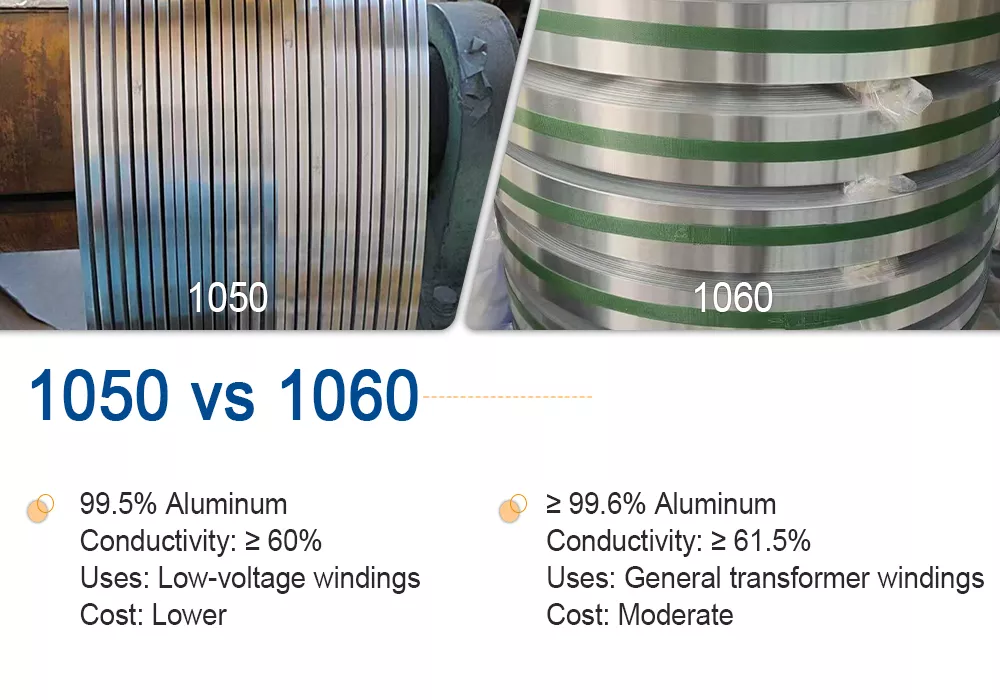
1050 vs 1060 Aluminum Strips for Transformer Windings Key Performance Comparison
| Comparison Dimension | 1050 Aluminum Strip | 1060 Aluminum Strip |
| Chemical Composition | Aluminum content ≥ 99.5% | Aluminum content ≥ 99.6% |
| Electrical Conductivity (%IACS) | Guaranteed to be above 60% | Guaranteed to be above 61.5% |
| Typical Applications | Low-voltage transformer windings | General transformer windings, especially dry-type transformers |
| Mechanical Properties | Certain tensile strength and elongation | Typically slightly higher strength, more durable |
| Cost and Maturity | Mature technology, relatively lower cost | Mature technology, moderate cost, commonly used series |
1050 vs 1060 Aluminum Strips Key Performance Differences in Transformers
-
Surface Quality and Burrs
Both alloys are typically processed to achieve "burr-free" edges. Because the hardness of 1060 is slightly lower, precision cutting tools must be used to ensure that the edges do not "smear," as this can lead to short circuits between winding layers.
-
Heat Dissipation
Due to the higher purity of 1060, its thermal conductivity is slightly higher than that of 1050. This helps to dissipate heat more effectively from the conversion process into the cooling medium (oil or air).
1050 vs 1060 Aluminum Strip Chemical Composition
The key difference between 1050 and 1060 aluminum strips lies in their aluminum content:
- 1050 Aluminum Strip: Contains aluminum content ≥ 99.5%. It is one of the most commonly used grades for transformer windings due to its cost-effectiveness, though it has slightly lower purity than 1060.
- 1060 Aluminum Strip: Contains aluminum content ≥ 99.6%, which gives it higher purity and, consequently, better electrical conductivity. This makes it a better choice for applications requiring higher performance.
The slight difference in aluminum content impacts not only the conductivity but also the mechanical properties of the two alloys.
1050 vs 1060 Aluminum Strip Electrical Conductivity
- 1050 Aluminum: Good conductivity, but slightly lower than 1060 due to its slightly lower purity.
- 1060 Aluminum: Better conductivity due to higher aluminum content, making it more suitable for high-efficiency transformer applications.
1050 vs 1060 Aluminum Strip Mechanical Properties
Pure aluminum is naturally soft, but the slight increase in impurities in 1050 gives it a minor edge in structural integrity.
The 1050 alloy is slightly harder and stronger, making it a better choice for windings that might face higher mechanical stress during the winding process or operation. Conversely, 1060 is more ductile, which allows it to be processed into thinner foils and strips with less risk of cracking.
1050 vs 1060 Aluminum Strip Cost
- 1050 Aluminum: Generally less expensive than 1060 aluminum, making it a more cost-effective option for transformer manufacturers who need to balance performance with cost.
- 1060 Aluminum: Due to its higher purity, it is slightly more expensive than 1050, but the increased conductivity might justify the price for some high-performance transformer designs.
1050 vs 1060 Aluminum Strip Applications
- 1050 Aluminum: Commonly used in general transformer applications and situations where cost is a critical factor but good conductivity is still required.
- 1060 Aluminum: Best suited for high-performance transformers where maximum electrical conductivity is needed, especially in high-voltage applications.
1050 vs 1060 Aluminum Strip Corrosion Resistance
Both grades offer excellent corrosion resistance in most environments, but 1060’s higher purity could give it an edge in more demanding conditions, particularly where moisture or chemicals are present.
1050 vs 1060 Aluminum Strip Weight and Strength
- 1050 Aluminum: Being a lower-purity alloy, it is lightweight but has slightly lower mechanical strength than 1060.
- 1060 Aluminum: While still lightweight, it may offer slightly greater strength and stability over 1050 due to the added aluminum content.
How to Choose?
- If your primary goal is to maximize electrical efficiency and minimize heat loss, choose 1060.
- If you need higher mechanical strength during manufacturing or prioritize cost-effectiveness, choose 1050, as it may be cheaper and more readily available.
After understanding the performance differences, how to choose depends mainly on the following three points:
- Consider performance needs: If the design goal is to pursue extreme energy efficiency and heat dissipation, or if the application has strict limits on temperature rise, 1060 aluminum with higher purity and better conductivity is the better choice.
- Consider cost budget: If the project has high cost requirements and moderate electrical performance needs, 1050 aluminum, with its reliable performance and lower cost, is an economical solution.
- Consider versatility: Currently, 1060 aluminum has become the general choice for many transformer manufacturers, especially in dry-type transformers.
Note: Both aluminum strips are typically in "O state" (i.e., annealed state), which makes them soft, with good plasticity and processability, suitable for winding.