
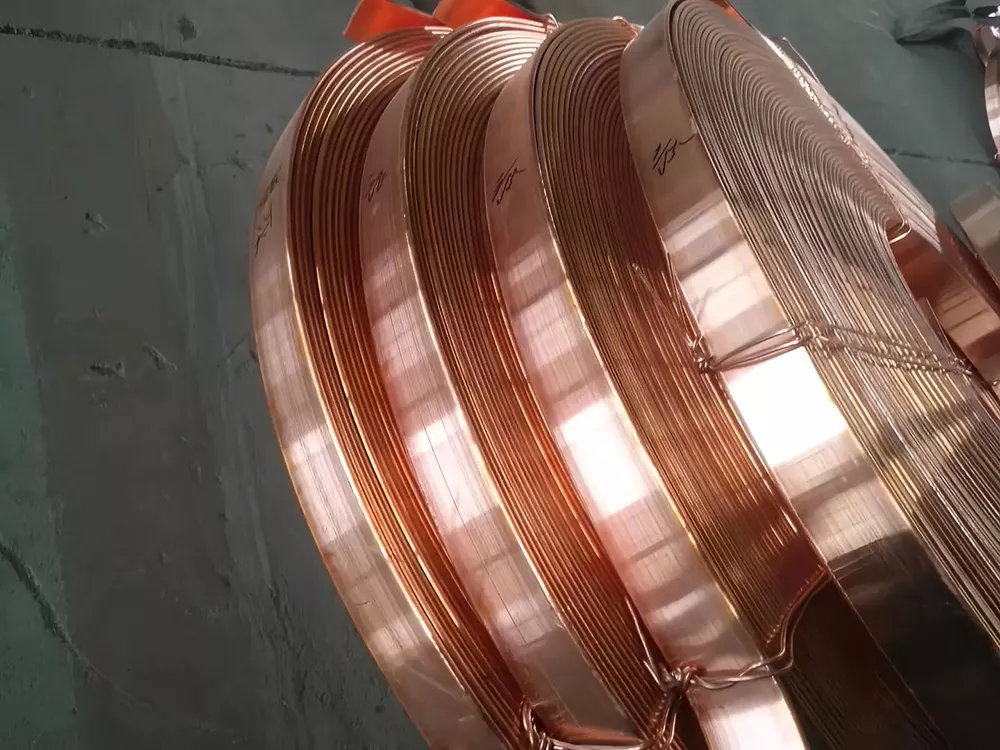
What are Transformer Copper Strips?
Transformer copper strip is a high-conductivity material, used as high-conductivity copper strip for foil-type windings, reducing eddy current losses and improving transformer energy efficiency. Thickness ranges from 0.1–3.5mm, with widths up to 1200mm.
Our transformer copper strip is a high-purity electronic material (copper content ≥99.95%), specifically designed for power distribution systems. It adopts a burr-free rounded edge design, which can significantly reduce partial discharge and local heating in electromagnetic coils, minimizing energy loss.
We supply copper strip to more than 80 transformer manufacturers. To address burr issues at the edges during low-voltage foil winding in dry-type transformers, we apply a “micro-chamfer + stress relief annealing” process, reducing winding breakage rates by 92%.
Transformer Copper Strip Technical Specifications
| Property | Specification |
| Material | Cu-ETP (T2 / C11000) |
| Copper Purity | ≥99.9% |
| Conductivity | ≥100% IACS |
| Thickness | 0.1 – 3.0 mm |
| Width | 5 – 1200 mm |
| Technical Standard | GB/T18813-2014 |
| Thickness Tolerance | ±0.015 mm (can reach ±0.01 mm) |
| Edge Treatment | Deburred / Rounded |
| Paper Core Internal Diameter | Ø150 mm, Ø300 mm, Ø400 mm, Ø500 mm paper core; special internal diameter core and coreless packaging available upon request |
| Surface Treatment | Mill finish, smooth surface, free from scratches and impurities |
| Packaging | Wooden pallet / wooden case |
| Payment Terms | 30% TT deposit and 70% balance before shipment, or 100% LC at sight |
| Delivery Time | 7–10 working days |
| MOQ | 500 Kgs |
Transformer Copper Strips Features
Our transformer copper strips deliver exceptional conductivity, precision tolerance, and thermal performance, making them ideal for high-efficiency transformer winding applications.
High Electrical Conductivity
- ≥99.9% IACS high purity copper
- Oxygen-free copper / high-grade cathode copper
- Stable conductivity up to 100.5% IACS
- Improves transformer efficiency by 5–10%
Reduces load loss and enhances overall transformer efficiency.
Precision Tolerance & Surface Quality
- Thickness tolerance: ±0.01 mm
- Burr-free, scratch-free surface
- Excellent edge consistency
- Lateral bending: ≤2 mm/m
Ensures smooth winding and minimizes insulation damage risk.
Superior Heat Dissipation
- Flat strip design increases surface area
- 30% higher heat dissipation than round wire
- Lower hotspot temperature
Improves cooling efficiency and extends transformer service life.
Transformer Winding Copper Strip Grade Comparison Across Global Standards (ASTM, EN, DIN, JIS, GB/T)
| Grade Name | Electrolytic Tough Pitch Copper |
| USA (ASTM B5, B152) | C11000 |
| Italy (UNI 5649) | Cu-ETP |
| China (GB/T) | T2 |
| EN 1652 | CW004A |
| DIN 1976 | E-Cu 58 |
| Japan (JIS) | C1100 |
Note: Although naming conventions differ, these grades are technically equivalent and widely used for transformer windings, busbars, and electrical conductors. Minor differences may exist in impurity limits and mechanical properties depending on the standard.
Transformer winding copper strips are produced according to multiple international standards. The most commonly used grade is C11000 (ETP Copper), known for its excellent electrical conductivity (≥100% IACS) and reliability in power transformer applications.
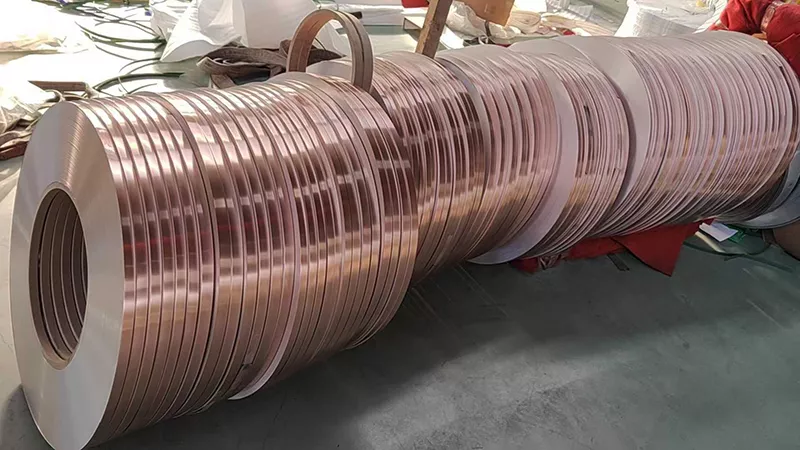
Transformer Copper Strips Chemical Composition
| Size (mm) | Weight (kg) | Cu (%) | Pb (%) | Fe (%) | Bi (%) | S (%) | As (%) | Sb (%) | Tensile Strength (MPa) | Hardness (HV) |
| 1.2446 × 440 | 904.0 | 99.990 | 0.0010 | 0.0020 | <0.0003 | 0.0011 | <0.0003 | <0.0002 | 235 | 57 |
| 1.2446 × 500 | 977.0 | 99.990 | 0.0010 | 0.0023 | <0.0003 | 0.0009 | <0.0003 | <0.0002 | 235 | 57 |
| 1.2446 × 570 | 3044.0 | 99.990 | 0.0010 | 0.0023 | <0.0003 | 0.0009 | <0.0003 | <0.0002 | 235 | 58 |
| 0.7112 × 485 | 648.0 | 99.990 | 0.0009 | 0.0022 | <0.0003 | 0.0010 | <0.0003 | <0.0002 | 231 | 55 |
Applications of Transformer Copper Strips
Distribution Transformers
Low-voltage side copper strip windings improve heat dissipation efficiency and reduce the risk of partial discharge.
Dry-Type Transformers
Copper foil winding structures are compact and suitable for commercial buildings, wind power, and photovoltaic substations.
Oil-Immersed Transformers
High mechanical strength copper strip ensures long-term corrosion resistance in oil immersion environments, with a service life exceeding 30 years.
High-Frequency Reactors
Ultra-thin copper strip (0.1–0.5mm) is used for high-frequency windings and electromagnetic shielding.
Manufacturing Process of Transformer Copper Strips
The manufacturing method of transformer copper strip involves rolling copper into extremely thin thicknesses (0.01mm to 3.0mm), followed by cold rolling or hot rolling depending on the required thickness. After that, annealing can be applied (to improve flexibility), and further processed into strip materials or composite sheets with insulating materials.
- Rolling: uniform grain structure
- Annealing: stress relief and improved flexibility
- Precision slitting: tolerance ±0.01–0.02mm
- Edge treatment: burr-free for safer winding
Transformers Copper Strips Quality Control & Certification
Transformer copper strips are manufactured under a strict end-to-end quality control system to ensure stable conductivity, precise dimensions, and reliable performance in transformer applications.
Surface & Dimensional Standards
- Smooth, clean, oil-free surface
- No scratches or visible defects
- Strict control of burrs, thickness, and width tolerance
- Stable winding performance and electrical contact reliability
Testing & Inspection
- 100% surface pinhole inspection
- Automatic thickness monitoring (0.1m sampling)
- Tensile strength & conductivity testing per batch
- Optional third-party verification (SGS)
Standards & Certifications
- ISO 9001
- RoHS 3.0 / REACH
- ASTM B152 / B170
- IEC 60228 / IEC 60494
- GB/T 18813-2014
- MTR (Material Test Report) included per batch
All products are fully traceable and tested to ensure compliance with international transformer manufacturing requirements.
Ready to Improve Transformer Efficiency?
We provide fast quotation and technical matching support for transformer copper strips, ensuring optimal material selection and cost efficiency.
Please provide the following parameters for an accurate quotation:
- Purchase quantity (kg / tons)
- Size specifications (thickness × width × coil length)
- Material grade (e.g. C11000 / TU1, etc.)
- Edge treatment (deburring / rounded edges)
- Coil inner diameter (200mm / 300mm / 400mm / 500mm)
Transformer Copper Strips Packaging
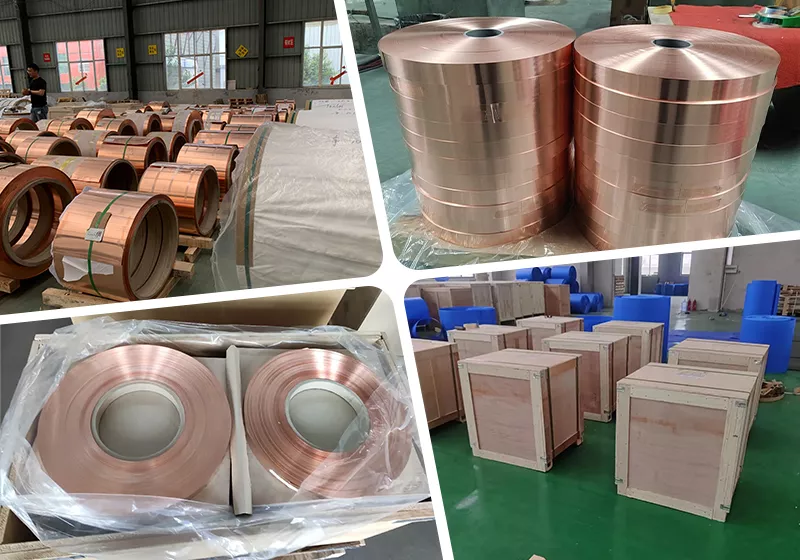
- Export standard wooden pallet or wooden case
- Coil form with strong paper core
- Inner diameter: 508 / 610 mm optional
- Moisture-proof and anti-oxidation protection
- Vertical or horizontal coil placement
- Clear labeling for easy identification
- Safe packing to prevent damage during storage and transport
Copper Strip vs Aluminum Strip
Copper strip and aluminum strip are two widely used conductor materials in transformer winding systems. The selection directly impacts efficiency, energy loss, thermal performance, mechanical stability, and total system cost.
Copper is preferred for high-performance and high-load applications, while aluminum is widely used in cost-sensitive and lightweight transformer designs.
| Feature | Transformer Copper Strip | Transformer Aluminum Strip |
| Electrical Conductivity | 100% IACS (Excellent) | ~61% IACS (Moderate) |
| Energy Loss | Very Low (low resistivity) | Higher (requires larger section) |
| Mechanical Strength | High tensile strength | Medium |
| Thermal Performance | Excellent heat dissipation | Good |
| Weight | Heavy | Lightweight (~1/3 copper) |
| Cost | Higher | Lower |
FAQ
Why choose copper instead of aluminum?
Copper has higher electrical conductivity and lower resistance, thereby improving transformer efficiency.
What is the standard thickness range of transformer copper strip?
The thickness range is typically 0.1mm–3.5mm. Distribution transformers commonly use 0.2–1.2mm, while large power transformers can reach 2.5mm or above.
What is the difference between oxygen-free copper and ETP copper for transformer windings?
Oxygen-free copper (OFC) has an oxygen content ≤0.001% and conductivity >101% IACS, suitable for high-frequency and hydrogen environments; ETP copper (electrolytic tough pitch copper, oxygen-containing) has a conductivity of 99.9% IACS, offers better cost efficiency, and is widely used in oil-immersed transformers.
How to choose between copper strip and aluminum strip?
If the transformer requires high efficiency, compact size, or high short-circuit strength, copper strip is the preferred choice; for cost-sensitive and space-available applications, aluminum strip can be considered, but a larger cross-sectional area is required.
How does copper strip improve transformer efficiency?
Rectangular copper strip improves the filling factor by 15–25%, reducing winding DC resistance; meanwhile, foil structures significantly reduce leakage flux and eddy current losses, improving overall efficiency by 1.5%–2.5%.
What is the minimum order quantity (MOQ)?
Sample MOQ is 500kg, bulk orders start from 5 tons. Customized width, edge chamfering, and semi-hard temper are supported.
What grade of copper is used?
T2/C11000 electrolytic copper is commonly used for transformer applications.
What is the delivery time?
If the goods are in stock, delivery usually takes 5–10 days. If not in stock, it takes 15–20 days depending on total order quantity.
Do you provide samples? Are they free or charged?
Yes, we can provide samples free of charge, but the shipping cost is not included.
Can I customize the product?
Of course. We will not start production until we receive your complete requirement details.